Once upon a time, ordering a coffee involved two questions. Now it requires a working knowledge of Italian, an understanding of milk chemistry and, occasionally, the confidence to admit you haven't got the faintest idea what you're asking for.
The other day, a collegue in our office asked a perfectly reasonable question.
"What's the difference between a latte and a white coffee?"
What followed was a surprisingly lengthy debate about something that, thirty years ago, nobody would have thought to question.
It didn't help that one of our other collegues is a dedicated tea drinker, for whom the entire conversation might as well have been conducted in Italian. As far as she was concerned, coffee was coffee, and the rest of us were making an unnecessarily complicated business out of it.
Which, to be fair, was rather difficult to argue with.
Because there was a time when coffee came in two varieties.
Black or white.
If you were feeling particularly adventurous, you might have it strong. Or weak. Or with two sugars.
That was about the extent of the decision-making process. You could order a coffee, receive a coffee and drink it before anyone had finished explaining what a macchiato was.
These days, ordering one can feel like negotiating a mortgage in a foreign language.
And somewhere along the way, we've all apparently become Italian.
From Nescafé to Naples
For much of Britain's recent history, coffee was a straightforward affair. A spoonful of instant, boiling water, a splash of milk and perhaps a sugar or two. If you were lucky, somebody had remembered to wash the mug properly.
Then came the high-street coffee chains.
Suddenly, coffee wasn't simply something you drank. It was something you ordered.
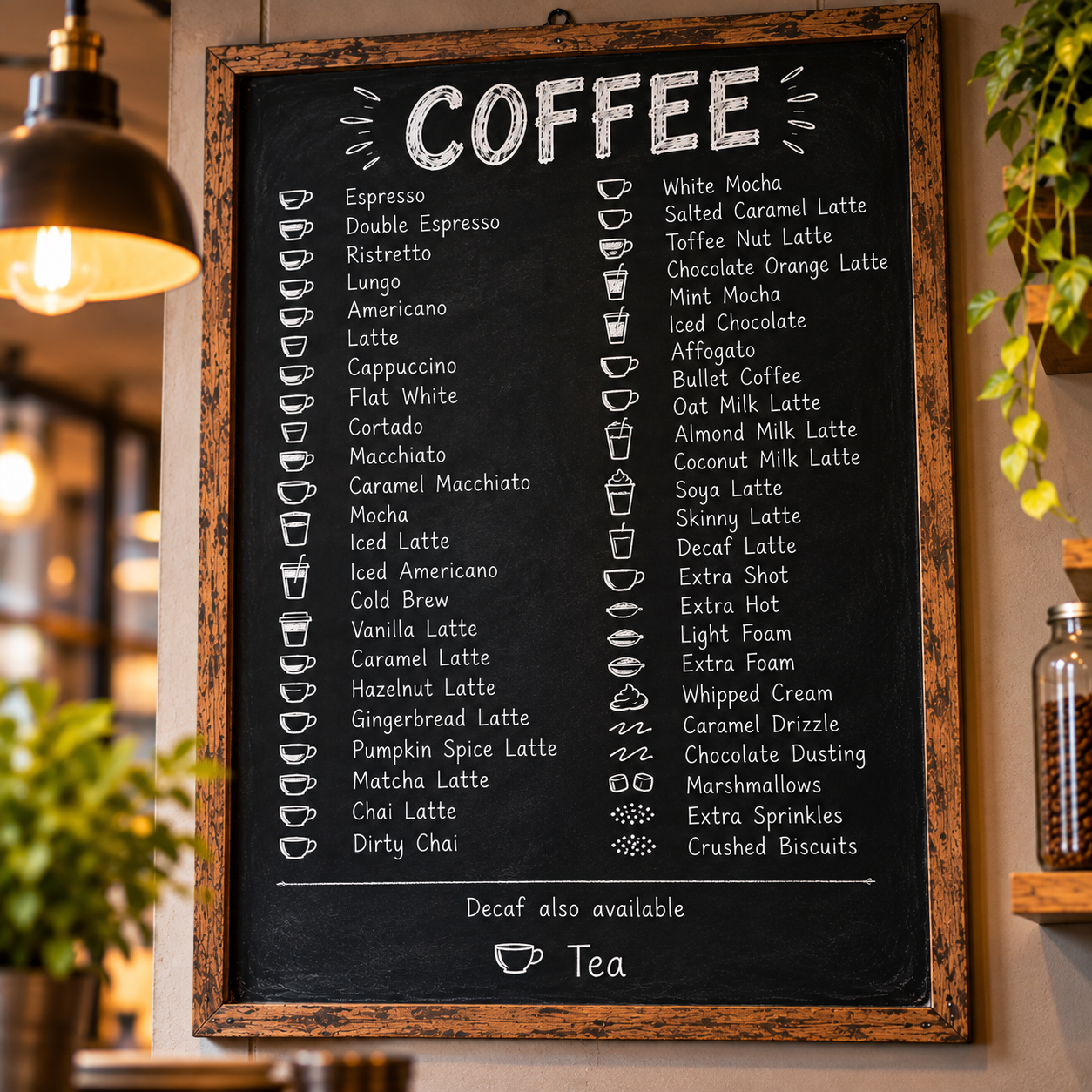
Espresso. Cappuccino. Latte. Americano. Macchiato. Flat white. Cortado.
Words that would once have sounded more at home on a menu in Florence than in a shopping centre in King's Lynn.
The remarkable thing is that most of these drinks contain exactly the same basic ingredients.
Coffee, water and milk.
It's what you do with them that causes the trouble.
First, Meet the Espresso
The foundation of most modern coffee-shop drinks is the espresso.
Hot water is forced under pressure through finely ground coffee, producing a small, concentrated drink topped with a golden-brown layer called crema.
It takes roughly half a minute to make and considerably less time to drink.
An espresso is what happens when coffee stops messing about.
It's short, strong and served in a cup that looks as though it belongs to a particularly well-dressed doll.
Order a double espresso and you get two shots. A ristretto uses less water for a shorter extraction, while a lungo uses more.
Already, we've managed to turn one drink into three without introducing milk.
But introduce milk we must.
Because that's where things become truly ridiculous.
The Great Milk Conspiracy
Take an espresso and add hot water. Congratulations, you've made an Americano.
Add a splash of milk and you've got something approaching what generations of British people simply called a white coffee.
But take an espresso, add plenty of steamed milk and a little foam, and suddenly it's a latte.
Use less milk and a more generous, airy foam topping, and it's a cappuccino.
Make a smaller drink with silky, finely textured milk and a stronger coffee-to-milk ratio, and you've got a flat white.
A cortado? Espresso softened with a relatively small amount of warm milk.
A macchiato? Traditionally, an espresso marked with a little milk or foam.
Which is rather lovely, until you discover that some coffee chains also sell something called a caramel macchiato, which bears about as much resemblance to the traditional version as a chocolate éclair does to a bread roll.
The real difference between many of these drinks isn't just the amount of milk. It's the texture.
When milk is steamed, tiny bubbles create a smooth, velvety consistency known as microfoam. A latte has plenty of steamed milk and a thin layer of foam. A cappuccino traditionally has a more substantial, airy topping. A flat white uses finely textured milk that blends smoothly with the espresso.
Naturally, the precise recipes vary between cafés.
Because apparently having seven names for coffee wasn't complicated enough. We also needed seven slightly different interpretations of each one.
And Then Somebody Added Pudding
Once the basic vocabulary had been established, somebody looked at a perfectly respectable cup of coffee and thought:
"You know what this needs? Chocolate."
Enter the mocha.
Espresso, milk and chocolate. Essentially a hot chocolate that's developed a caffeine dependency.
Then came the flavoured syrups.
Vanilla. Caramel. Hazelnut. Gingerbread. Pumpkin spice.
Before long, people were ordering drinks that sounded less like beverages and more like the ingredients for a Christmas cake.
But apparently, even that wasn't enough.
Somewhere along the line, somebody decided that coffee needed toppings.
Whipped cream. Chocolate dusting. Caramel drizzle. Marshmallows. Chocolate curls. Crushed biscuits. Occasionally something resembling an entire confectionery aisle balanced precariously on top.
At this point, we've moved beyond making a drink and started constructing a pudding.
Some of these creations arrive in cups so large they require two hands, topped with a mountain of whipped cream that has to be excavated before you can even reach the coffee.
And there's always a straw poking out of the top, presumably because a spoon would make it too obvious that you've ordered dessert.
Coffee has somehow evolved into something you eat first and drink second.
I'm fairly certain that if you tipped one of these creations upside down, the coffee would be the last thing to fall out.
And yet, despite all this, the person ordering it will still quite confidently announce:
"I'm just popping out for a quick coffee."
Of course you are.
See you Thursday.
"A large, iced, oat-milk, sugar-free vanilla latte with an extra shot, whipped cream, caramel drizzle and chocolate sprinkles, please."
Try saying that three times quickly.
Better still, try remembering it while standing behind six people in a queue, all of whom appear to be ordering something requiring a written specification.
Even the sizes have become complicated.
Small, medium and large used to be perfectly adequate.
Now we have short, tall, grande and venti.
At certain coffee chains, tall is actually one of the smaller options.
This is the sort of linguistic development that would have caused considerable confusion in a primary school maths lesson.
"Which is bigger, children? Tall or grande?"
"Please, Miss, can we just have some milk?"
And spare a thought for the poor barista, expected to remember the drink, size, milk type, number of shots, syrup, temperature, foam preference and whether the customer would like half a packet of biscuits balanced on top.
All while smiling.
The Mastermind Specialist Subject
I can already imagine the scene.
"Your name, please?"
"Darren."
"Your occupation?"
"Business development."
"And your specialist subject?"
"The subtle differences between espresso-based milk beverages, 1995 to the present day."
"Your time starts now."
"What is the principal difference between a traditional cappuccino and a flat white?"
"Foam texture and milk-to-coffee ratio."
"Correct. What does macchiato mean?"
"Marked."
"Correct. What is a cortado?"
"An espresso cut with a small amount of warm milk."
"Correct. And what is the difference between a latte and a white coffee?"
"Well, that rather depends on what you mean by white coffee, how the milk is prepared, the volume of the drink and whether the establishment follows traditional Italian conventions or its own interpretation—"
BEEP! BEEP! BEEP!
"I've started, so I'll finish."
Back to the Office
Which brings us back to the original question.
What's the difference between a latte and a white coffee?
In the simplest terms, a traditional British white coffee is ordinary brewed or instant coffee with milk added.
A latte is an espresso-based drink made with a generous amount of steamed milk and a little foam.
Different preparation, different texture, usually a different balance of coffee and milk.
And, quite often, a different price.
But here's the wonderful thing about coffee.
For all the terminology, the traditions, the arguments about foam thickness and the extraordinary number of ways we've found to combine three basic ingredients, most people still want exactly the same thing.
A decent cup of coffee that tastes how they like it.
Whether that's a double espresso, a beautifully made flat white or a mug of instant with two sugars and enough milk to make it look like builder's tea is entirely up to them.
There isn't a right answer.
Although, if you do find yourself standing in a coffee shop, feeling slightly overwhelmed by the menu, there's always one reliable option.
"Can I just have a coffee, please?"
Just don't be surprised when they ask you seventeen follow-up questions.