What Is Self-Service, and What Next?
If you’ve ever poured your own pint, scanned your own shopping, or bravely attempted to check out of a hotel without angering a touchscreen, congratulations — you’ve participated in the grand British tradition of self-service.
But what actually is self-service? Where did it come from? And how on earth did we get from holy water in ancient temples… to self-service grocery checkouts shouting “Unexpected item in the bagging area” at us like a passive-aggressive aunt?
Grab a brew (ideally from a vending machine — for thematic accuracy), settle in, and let’s take a stroll through the surprisingly long, occasionally bizarre, and increasingly digital history of doing things ourselves
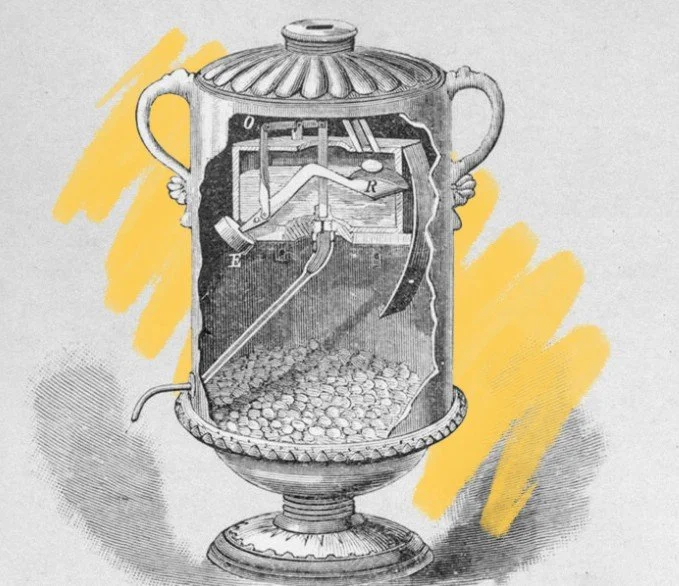
Hero’s Holy water dispense
The First Self-Service Ever: Holy Water, Ancient Greece & Divine DIY
The earliest known self-service device is credited to Hero of Alexandria around 215 BC. His invention?
A coin-operated machine that dispensed holy water.
That’s right. Thousands of years before we had Costa Express machines, we had the “Sacred Water Vend 1.0” — a proper ancient vending machine. Insert a coin, a little mechanism dropped, and out came a measured dose of blessed water. No staff. No queues. No “have you tried turning it off and on again?”
Fast forward a couple of millennia, and self-service is everywhere — from ordering a Big Mac to checking in at Gatwick.
But let’s not skip the fun bits in between.
From Clerks to Carts: How Supermarkets Taught Us to Help Ourselves
Before the 1900s, grocery shopping was basically this:
Write a list
Hand it to Arkwright (or your local shop owner)
Watch them wander around collecting everything for you
Hope they don't judge you for buying that much butter
Then in 1916, an American shop called Piggly Wiggly introduced a revolutionary concept:
Let customers pick things up themselves.
Unfortunately this didn’t make it to our UK shores until January 1948, when London Co-operative Society opened its first self-service supermarket in Manor Park, London.
It seems painfully obvious now, but at the time it was a retail plot twist on the level of “It was the butler all along.”
The shopping basket, shelves customers could walk up to, and eventually trolley systems transformed retail forever — setting the stage for every self-serve system we use today.
In the UK, this became the Tesco and Sainsbury’s we now know, eventually followed by the great leap forward (or backward, depending on your patience level): self-checkout machines.
Ah yes, the machines that give us freedom… and judgment.
If purgatory has a sound, it’s definitely “Please wait for assistance.”
ATMs: The Original ‘Don’t Make Me Talk to Someone’ Technology
Self-service took a major leap in 1967, when Barclays in Enfield unveiled the world’s first modern ATM.
For the first time, you could withdraw cash without speaking to a soul. For Brits — a nation that loves avoiding unnecessary social interaction — this was bliss.
ATMs quickly spread, reducing queues, extending service hours, and allowing us to check our balance at 2am and immediately regret our life choices.
Modern banking has taken self-service even further:
Online transfers
Mobile cheque deposits
Apps that tell you exactly how irresponsible you’ve been this month
Banks love it because it reduces staff workload. Customers love it because it avoids awkward conversations like, “Yes, I did buy 17 items on Amazon after midnight.”
Airports: The Self-Service Olympics
If you really want to see how far self-service has come, go to an airport.
Once upon a time, you’d queue to speak to a human who would print your boarding pass with a smile (or at least a convincing imitation of one).
Now?
Check in yourself
Print your own tag
Weigh your bag
Load your bag onto the belt
Pray the machine doesn’t eat your passport
By the time you reach the actual gate, you’ve done so many tasks you should technically qualify for an airline employee discount.
Hotels followed suit — online booking, digital room keys, check-in kiosks, and apps replacing reception desks entirely. During the pandemic, guests discovered they preferred not having to talk to anyone. Many never looked back.
Restaurants: The Rise of the Touchscreen Chef
From McDonald’s ordering kiosks to Wetherspoons’ legendary table-service app, dining has become a choose-your-own-adventure experience.
Self-service in restaurants removes:
Waiting to catch someone's eye
Shouting your order over a loud kitchen
Saying “no onions” four times and receiving extra onions anyway
Screens let customers customise everything, which is great unless you're behind someone crafting the world’s most precise sandwich:
“Extra bacon… no, not that bacon… substitute the mayo with aioli… but like, lightly…”
Still, it speeds things up and reduces miscommunication. And for businesses? It’s efficient, scalable, and surprisingly profitable.
Vending Machines: The Oldest, Coolest, and Sometimes Strangest Self-Service Heroes
We can’t ignore the OGs: Vending Machines.
From the original holy water dispenser to today’s sleek digital units, vending has always been the purest form of self-service:
Want something
Press button
Get thing
Simple. Elegant. Reliable. Unless the snack gets stuck — a universal tragedy…
In the UK, vending machines now offer everything from PPE to pizzas, from fresh milk to phone chargers. And with smart telemetry, cashless payments, and remote stock monitoring, they’re evolving faster than ever.
At H2O Vend, we see this shift daily. Whether it’s bean-to-cup coffee machines, cold drink and snack machines, smart fridges, or micro-markets, customers increasingly prefer fast, frictionless, human-free service.
And businesses? They love reduced labour costs, predictable service, and the ability to operate 24/7.
Unmanned Retail: The Shop With No Shopkeepers
The next evolution of self-service is already here — stores without staff.
Think:
Amazon Fresh walk-out technology
Smart fridges (like our very own H2O Grab&Go)
Micro-markets in workplaces
Automated corner shops in residential areas
No tills. No queues. No awkward “just browsing, thanks.”
Just walk in, take your items, and leave. Sensors and cameras handle the rest.
It’s like shoplifting, but legal!!
Why Do We Love Self-Service So Much?
The modern customer wants:
Speed — nobody wants to queue behind someone who still pays with cheques
Convenience — tap, grab, go
Control — order exactly what you want
Privacy — no eyes judging your 3rd meal deal of the day
Consistency — machines don’t have bad days
Availability — 24/7 operation
And businesses want:
Lower staffing costs
Better accuracy
Faster throughput
Digital tracking and analytics
Scalable service
It’s a win-win — except for people who hate technology, but they’ll come around eventually.
So… What Is Self-Service, Really?
At its core, self-service is the automation of tasks previously done by humans.
Banking, shopping, ordering food, picking up parcels, hotel check-ins — all transformed by letting customers do things themselves, with help from machines.
Self-service kiosks aren’t just novelties — they’re essential. They cut labour costs, increase speed, reduce queues, improve accuracy, and boost customer satisfaction.
It’s no exaggeration to say that self-service isn’t just a trend — it’s the backbone of modern retail.
What’s Next? The Future of Self-Service
Here’s where it gets exciting.
1. AI-Powered Kiosks
Imagine ordering a sandwich from a kiosk that remembers your last order and suggests improvements.
Or a hotel kiosk that recognises your face and hands you your key in seconds.
2. Fully Autonomous Stores
We’ll see more unmanned shops, micro-markets, and smart fridges acting like mini supermarkets in workplaces, gyms, campuses, and recreational areas.
3. Hyper-Personalisation
Your fridge, your phone, and your workplace coffee machine might soon collaborate to decide what you want before you know.
Terrifying? Maybe. Convenient? Absolutely.
4. Better Connectivity
4G LTE and 5G allow kiosks and vending machines to stay online, update prices, track stock, report faults, and take payments seamlessly.
Without connectivity, self-service collapses. With it, automation flourishes.
5. The Rise of the Smart Vending Ecosystem
At H2O Vend, we’re already seeing:
Machines that reorder stock automatically
Remote diagnostics
Cloud dashboards
Personalised product offerings
Cashless everything
Smart vending is no longer just a machine — it’s a miniature unmanned retail business.
Conclusion: Self-Service Isn’t Replacing People — It’s Replacing Waiting
From ancient holy water to 21st-century smart fridges, self-service has always been about one thing:
Helping people get what they want, faster, easier, and with less faff.
Humans aren’t going anywhere — we’ll just spend less time doing repetitive tasks and more time doing the things that matter.
And in the world of vending and automated retail?
The future isn’t just coming… it’s already here, humming quietly, taking contactless payments, and politely reminding you to remove your item.
#SelfService #Automation #VendingMachines #RetailTech #SmartVending #FutureOfRetail #TechTrends #CustomerExperience #RetailTechnology #UnmannedRetail #SmartVending #CustomerExperience #DigitalTransformation #TechInnovation #VendingIndustry #H2OVend #Grab&Go