The workplace kitchen used to be somewhere you disappeared into for a cup of tea. These days, it's increasingly part of the room itself. And as the boundaries between kitchens, dining areas and places to relax begin to disappear, even the humble drinking-water tap is having to evolve.
There is something wonderfully predictable about the British workplace kitchen. Whether it's a gleaming office development, a factory canteen or a converted Portakabin on an industrial estate, certain things are almost guaranteed. There will be a microwave that has seen things no microwave should ever have to endure, a fridge containing at least one unidentified lunch that nobody is prepared to claim, and a collection of mugs advertising companies that ceased trading sometime around 2007.
Somewhere amongst this domestic chaos will be a water cooler and a hot-water boiler. One provides cold water, the other hot, and it's an arrangement so familiar that nobody thinks to question it. Why would they? Both do their jobs perfectly well, and we've spent more than 30 years supplying, maintaining and occasionally rescuing them from the consequences of enthusiastic but misguided human intervention.
But something rather interesting has been happening to the places where people take their breaks.
For years, the workplace kitchen was a functional room, usually tucked away behind a door. You went in, made your tea, perhaps exchanged a few words with whoever was wrestling with the microwave, and returned to the canteen or staffroom. The kitchen itself wasn't particularly important. Provided the kettle worked, the fridge was cold and nobody had stolen your milk, it was doing its job.
Today, that arrangement is becoming less common.
In newly designed and refurbished workplaces, the kitchen is increasingly part of the wider refreshment area, open to the seating and dining space rather than hidden away in a separate room. Worktops flow into communal areas, appliances are integrated into cabinetry, and the whole environment is designed to feel less like an institutional canteen and more like somewhere people might actually choose to spend their break.
The kitchen is no longer simply somewhere refreshments are prepared. It's part of the space where people sit, talk, eat and occasionally solve problems that three meetings and an unnecessarily complicated spreadsheet have failed to resolve.
And once the kitchen becomes part of the room, everything in it becomes rather more visible.
The large boiler sitting on the worktop, perfectly acceptable when concealed behind a kitchen door, suddenly looks a little out of place alongside carefully chosen cabinetry and modern finishes. The freestanding water cooler, once conveniently tucked into a corner, becomes another appliance that somebody has to design around.
Neither has become any less useful. They've simply found themselves in surroundings that have changed.
Which is where the humble tap enters the story.
Anyone familiar with modern domestic kitchens will probably have encountered instant boiling-water taps, popularised by brands such as Quooker. What began as something of a luxury addition has gradually become a practical alternative to the traditional kettle, with the heating equipment concealed beneath the worktop.
Commercial integrated taps take the same principle and adapt it for the different demands of a workplace, where hot drinks and chilled drinking water may be required throughout the day, sometimes by a considerable number of people.
We've recently completed our first installations of integrated Ezytap systems as part of the refurbishment of two staff kitchen areas at an established commercial customer. They were an interesting addition to the project because, once installed, there was remarkably little to see.
Above the worktop sits a neat, modern tap, with a small digital control panel positioned at the top. It looks purposeful without being particularly conspicuous, fitting naturally into the clean lines of the refurbished kitchens.
The equipment doing the actual work is somewhere else entirely.
Open the cupboard beneath the tap and you'll discover that the apparent simplicity is something of an illusion. A system providing both hot and chilled water requires a boiler, refrigeration equipment, filtration and the associated plumbing. Together, these can occupy virtually an entire standard kitchen base cabinet.
The Ezytray beneath the dispensing point also needs connecting to a suitable waste outlet, which is worth remembering before the kitchen designer decides that the cupboard would make an excellent home for the cleaning supplies.
It's one of the more amusing contradictions of modern technology. We celebrate how compact and discreet everything has become, while quietly relocating a surprising amount of machinery into places nobody can see.
But in an open-plan refreshment area, the space above the worktop is part of the room everyone experiences. The space beneath it is largely functional. Moving the equipment from one to the other allows the kitchen to serve its purpose without dominating its surroundings.
Of course, the arrangement only works if somebody has thought about it properly.
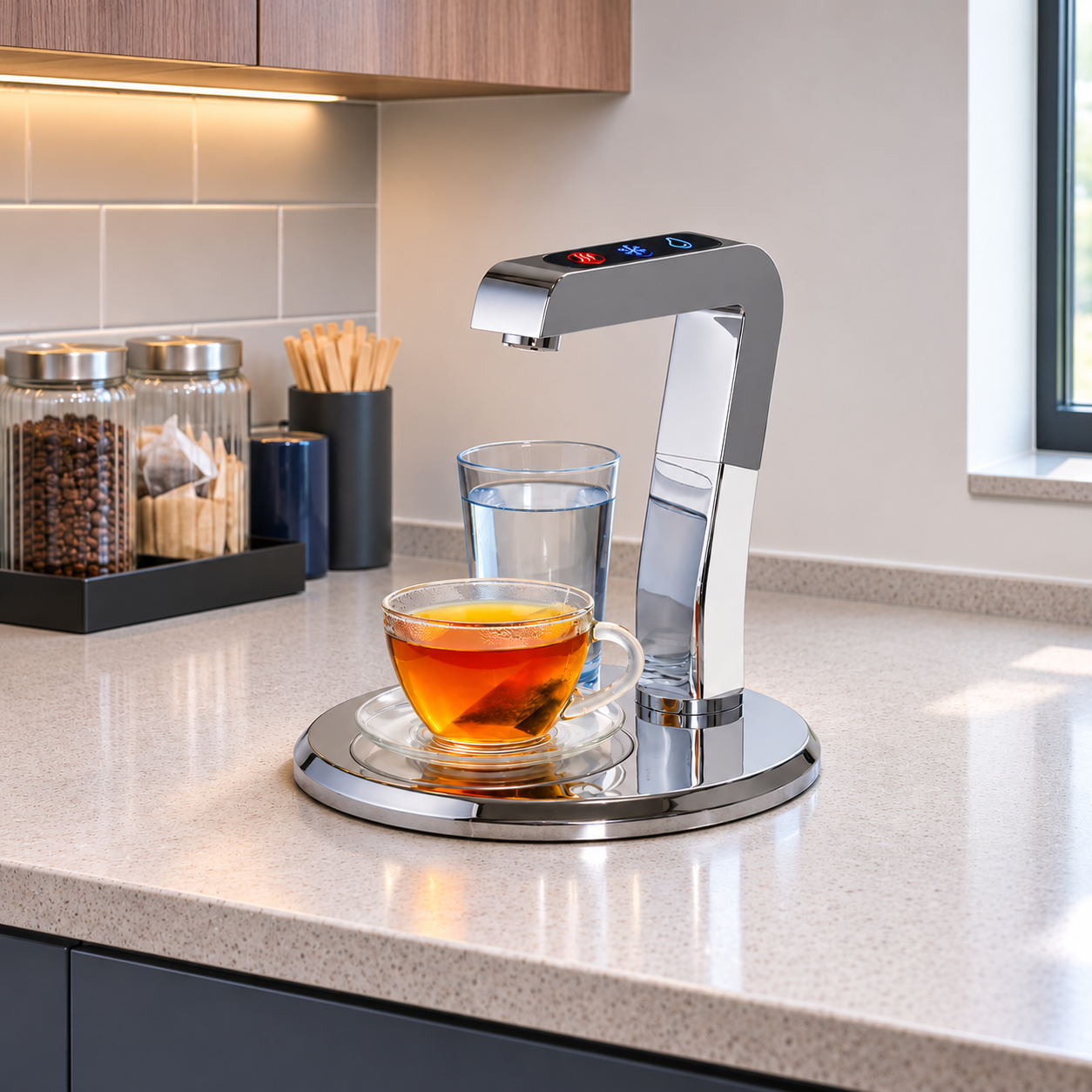
Integrated taps are particularly well suited to new kitchen designs and refurbishments because the necessary space, plumbing and electrical connections can be incorporated from the beginning. They are rather less convenient when someone decides to add one after the cabinetry has been installed, the plumbing boxed in and every available cupboard filled.
There's also the small matter of ensuring that the equipment can actually deliver what people expect.
A quiet office where staff make drinks at different times throughout the day places relatively modest demands on its water supply. A busy factory canteen where forty employees arrive for their break at precisely ten o'clock is an entirely different proposition. Everyone wants tea, nobody wants to wait, and the elegance of the tap becomes considerably less important than the amount of hot water available behind it.
The Ezytap range reflects these different requirements, with four-litre and eight-litre undercounter boiler options, alternative tap heights and configurations offering hot, ambient or chilled drinking water. Choosing between them isn't simply a matter of selecting the largest or most expensive model. It's about understanding how the space will be used, when demand will occur and what the equipment needs to deliver.
A beautifully designed kitchen is of little consolation to someone standing in a queue with an empty mug.
Then there's the water itself, which in East Anglia has a habit of making life rather interesting for anyone responsible for heating it.
Hard water doesn't discriminate between a traditional countertop boiler and a sophisticated undercounter system. Given enough time, limescale will happily accumulate inside either, and the fact that one is hidden behind an expensive cupboard door offers no protection whatsoever.
For that reason, we specify our own filtration systems according to anticipated water consumption and local water conditions, rather than simply fitting the same filter to every installation. The objective is to protect the equipment, maintain water quality and ensure that replacement intervals are appropriate for the amount of water being used.
It's also important that the equipment remains accessible. Filters need changing, boilers need maintaining and chilled-water systems require appropriate hygiene care. The engineer who eventually has to work on the installation will be considerably more appreciative of a sensible layout than an additional inch of decorative cabinetry.
The machinery hasn't disappeared. It's simply moved somewhere the kitchen designer would rather you didn't look
There are practical limitations, too. Concealing equipment beneath a worktop doesn't automatically make it more energy-efficient, and an integrated system won't necessarily be the right answer for every workplace. Traditional boilers and water coolers remain excellent solutions, particularly where high demand, unusual layouts or the need for multiple dispensing points make separate appliances more practical.
But the interesting thing about integrated taps isn't really the technology.
It's what their growing popularity tells us about the changing workplace.
For much of the last century, staff facilities were designed primarily around function. They needed to be durable, straightforward to maintain and capable of serving the people who used them. Appearance was generally a secondary consideration, and quite reasonably so.
Today, businesses are paying greater attention to the environments their employees occupy throughout the working day. Break areas are becoming more welcoming, kitchens more thoughtfully designed, and the distinction between functional equipment and the surrounding space is becoming less obvious.
That doesn't mean every staffroom needs to resemble the kitchen showroom of an expensive Scandinavian furniture company. Nor does it mean that traditional equipment has somehow become obsolete.
It simply means that the way we think about these spaces is changing.
After more than 30 years of installing water coolers and boilers, there's something rather satisfying about seeing the same familiar services delivered through a single, neatly integrated fitting.
The first time you encounter one, the little digital display might catch your attention. You might open the cupboard to discover where everything has gone. You might even appreciate how much cleaner the kitchen looks without the usual collection of appliances.
Then you'll make your cup of tea, return to your colleagues and probably never think about it again.
Which is rather the point.
Sometimes progress doesn't arrive with flashing lights, elaborate controls or a revolutionary new invention.
Sometimes it just looks like a tap.