It's Only Water. What Could Possibly Go Wrong?
It's clear, it comes out of the tap, and most of us give it less thought than the biscuits in the office kitchen. Yet the water flowing through our coolers, boilers and coffee machines has a rather complicated relationship with the equipment we expect to work every day. And occasionally, it makes its feelings known.
There are few things in life quite as reassuringly uncomplicated as a glass of water. You turn on the tap, fill a glass and carry on with whatever you were doing before you became thirsty. At work, you might visit the water cooler, press a button and wait for something cold and refreshing to appear. Perhaps you prefer your water hot, in which case another button will oblige. Or you might wander over to the coffee machine, select a cappuccino and watch a remarkably sophisticated piece of engineering turn water, coffee beans and milk into something resembling civilisation.
The stuff falls out of the sky, comes out of the tap and has been doing so for rather longer than any of us have been around. We wash cars with it, boil potatoes in it and make tea with it. It seems unreasonable that something so familiar should require a technical assessment before being allowed anywhere near a coffee machine or water cooler. Unfortunately, water is rather more complicated than it looks, and after over thirty years of supplying and maintaining workplace refreshment equipment, we've learned that some of the most expensive problems begin with the cheapest ingredient.
The Problem With Perfectly Good Water
The public mains supply in the UK is treated and monitored to meet drinking-water standards. Filtration in workplace refreshment equipment isn't generally about making unsafe water safe. It's about understanding the difference between water that's safe to drink, water that's pleasant to drink and water that's suitable for repeatedly heating inside an expensive piece of equipment. Those are three rather different considerations, even though they all begin with the same tap.
A cold-only mains-fed cooler connects to the building's drinking-water supply, chills it and dispenses it. Compared with a coffee machine, it seems wonderfully straightforward. Yet taste matters. Chlorine-related flavours and odours can be noticeable, and suitable activated carbon filtration can help reduce them. There's little point installing a cooler to encourage people to drink more water if everyone takes one sip, pulls a face and returns to the kitchen tap. People rarely compliment a water cooler for producing water that tastes exactly as expected, but they're remarkably quick to notice when it doesn't.
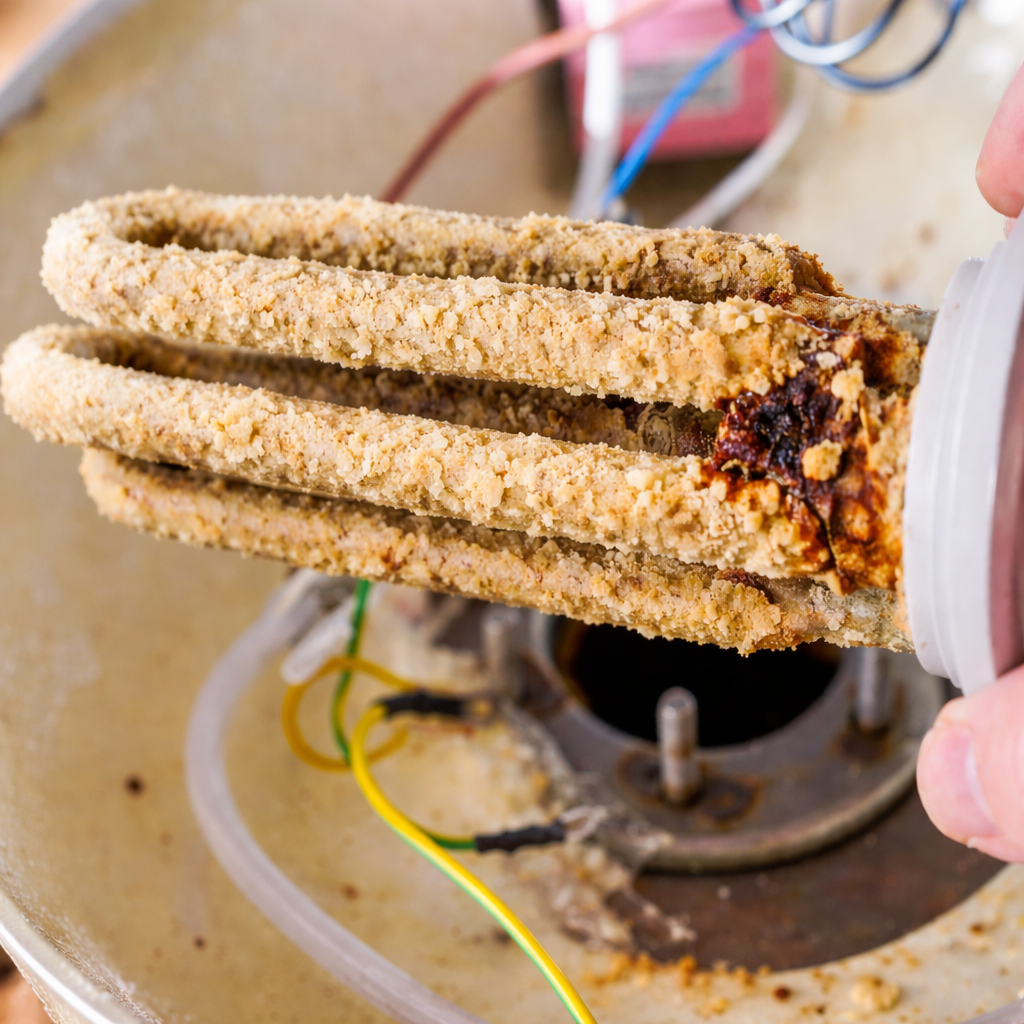
Introduce a hot-water function, however, and the requirements change. Much of East Anglia has hard water, thanks in part to the chalk and limestone through which it travels. As water passes through the ground it dissolves naturally occurring minerals, particularly calcium and magnesium compounds. There's nothing inherently wrong with that; the minerals are a normal part of drinking water. But repeatedly heating mineral-rich water can encourage calcium carbonate deposits to form. Most of us know the result as limescale, the pale crust that gradually turns the inside of a domestic kettle into something resembling a geological exhibit.
Deposits can coat heating elements, restrict passages, interfere with level probes and cause valves to stick or block. We see those faults regularly. A hot and cold cooler may have a relatively compact heating system, while a commercial coffee machine can contain boilers, pumps, probes and narrow waterways, all of which depend on water moving through the equipment in a controlled manner. Limescale doesn't particularly care how much the machine costs. It simply accumulates wherever conditions allow it.
The equipment may behave perfectly for months while deposits build slowly inside. Then one morning the machine decides that producing hot drinks is no longer in its job description, and somebody phones us. The customer sees a machine that worked yesterday and doesn't work today. Our engineer sees the possible result of a problem that may have been developing quietly for a considerable time.
WATER THAT'S PERFECTLY SAFE TO DRINK ISN'T NECESSARILY IDEAL FOR THE EQUIPMENT THAT HEATS IT.
A Quarter of a Boiler That Wasn't Boiler Any More
Not long ago, a business asked us to investigate problems with a coffee machine we'd neither supplied nor installed. That isn't unusual. When a machine stops producing cappuccinos, there is often a genuine sense of personal betrayal, and somebody needs to establish what has gone wrong. Our engineer discovered that an inline water filter had been fitted, which was encouraging until it became apparent that nobody had changed it for years. Exactly how many years wasn't clear, which is rarely a promising start to a conversation about routine maintenance.
The boiler was rather more forthcoming. Approximately a quarter of its internal volume was occupied by accumulated limescale. The heating element was heavily encased and the water-level probes were coated in deposits. A boiler is supposed to heat water, not become a permanent exhibition of East Anglian geology, and losing roughly 25% of its capacity to mineral deposits is unlikely to feature in anybody's recommended operating conditions. We can't establish precisely how much of the accumulation could have been avoided with properly maintained filtration, because we didn't know the machine's full history. But the condition of the boiler was a fairly graphic reminder of what can happen when water treatment is installed and subsequently forgotten.
The awkward thing about an exhausted filter is that it may still look perfectly serviceable. Water can continue flowing through it, the casing remains intact and no alarm necessarily announces that the treatment media have reached the end of their useful life. From the outside, everything appears normal, even though the equipment downstream may no longer be receiving the intended protection. It's a little like keeping an empty fire extinguisher on the wall because it still looks reassuringly red.
Nor are all filters trying to achieve the same thing. Cold-only coolers generally need taste and odour improvement, often through activated carbon. Hot and cold coolers may also benefit from scale control, which can be provided using suitable phosphate-based treatment. This helps inhibit scale formation without necessarily removing the hardness minerals themselves. Commercial coffee equipment often requires a different approach, combining carbon filtration with decarbonisation resin to reduce carbonate hardness. An adjustable bypass head can then allow a controlled proportion of incoming water to mix with the treated supply, helping achieve an appropriate balance between equipment protection and beverage quality. Our H2O Café Vend filtration range combines these technologies, with three cartridge capacities to suit different water conditions and equipment requirements.
This is why treating cartridges as interchangeable simply because they fit a pipe is rather like assuming every filter in a vehicle performs the same job. The water, the equipment and the purpose of the treatment all matter. And choosing the correct filter begins with something considerably more useful than guesswork.
The Trouble With Guessing
Imagine two identical coffee machines installed in different workplaces, making roughly the same number of drinks. Their water filters could have very different working lives simply because the incoming water has different hardness levels. The treatment capacity of a hardness-reduction cartridge isn't necessarily a fixed number; it depends on how much mineral content the filter has to manage. The technical information for the filtration technology used in our new Café Vend range illustrates this clearly. Under the manufacturer's published conditions, a medium cartridge can treat approximately 5,000 litres towards the softer end of the specified hardness range, but substantially less than 1,000 litres at the hardest end. It's the same physical cartridge, yet the amount of water it can effectively treat is dramatically different.
Our engineers therefore test the incoming water hardness when installing a new filtration setup, rather than assuming that every East Anglian tap behaves identically. That measurement helps determine the appropriate treatment and bypass setting. We also estimate consumption from the number and size of drinks being dispensed, allowing for cleaning and rinsing cycles where relevant. A coffee machine in a small office may have a predictable pattern of use, while an apparently identical machine in a busy factory could be operating across several shifts. Water coolers have their own variations: a quiet reception area and a busy production facility are unlikely to have identical demands, particularly during a summer heatwave.
We err on the side of caution, because a cartridge that runs out of treatment capacity well before its next service isn't much of a saving. And when reality refuses to follow our original estimates, we can temporarily install an inline flow meter to measure actual consumption over a representative period. It's a wonderfully unglamorous solution to a surprisingly important question. Rather than continuing to speculate about how much water a machine might be using, we measure it.
Consider a coffee machine producing 100 drinks on each working day, averaging 200ml of water per drink. That's about 440 litres over a 22-day month for the drinks alone, before cleaning and rinsing. Over six months, the drinks account for more than 2,600 litres. A nominal 3,000-litre cartridge might initially appear adequate, but whether it actually is depends on the hardness, bypass setting and total consumption. In harder water, its effective treatment capacity could be considerably lower than the figure suggested by its name.
THE RIGHT FILTER ISN'T NECESSARILY THE BIGGEST. IT'S THE ONE THAT MATCHES THE WATER, THE EQUIPMENT AND THE WAY IT'S USED.
There's also time to consider. At H2O Vend our standard replacement interval is six months, or sooner when consumption, water conditions or the applicable manufacturer's guidance require it. A filter may reach its treatment capacity before six months, while another may have treated relatively little water but still be due for replacement because of its time in service. Capacity and age are separate considerations, and the fact that water continues flowing through a cartridge doesn't establish that it's still providing the intended treatment.
Water coolers need a further distinction. Filtration isn't sanitisation. Bottled coolers generally don't use the same inline filtration arrangements as mains-fed machines, because the water arrives as a prepared drinking-water product. Nevertheless, the dispenser still requires appropriate cleaning and sanitisation. Likewise, installing a new carbon filter in a mains-fed cooler doesn't remove the need to maintain the cooler itself. Bottled and mains-fed water coolers together account for almost 40% of our business, and keeping them operating reliably involves considerably more than ensuring that water comes out when somebody presses a button.
Putting Our Name on the Invisible Bit
For years we've bought filtration products from established manufacturers, using three different suppliers to cover the various coolers and coffee machines we maintain. It worked, but it also meant different ranges, different heads and different purchasing arrangements. As our business has grown, we've increasingly tried to offer customers one coordinated service covering equipment, maintenance and consumables. Bringing the filtration products together was a logical next step, with the added advantages of simpler stock management, bulk purchasing and better margins. There's no need to pretend that running a more efficient business isn't part of the attraction; vans, engineers and replacement stock have an unfortunate habit of costing money.
The result is two H2O Vend branded families: Café Vend for commercial coffee equipment and Cooler Vend for mains-fed drinking-water coolers. The underlying cartridges use established industry technology. We haven't discovered a new element or reinvented water chemistry; we've selected a range that suits the equipment we work with, brought it under one name and made it part of our wider service offering.
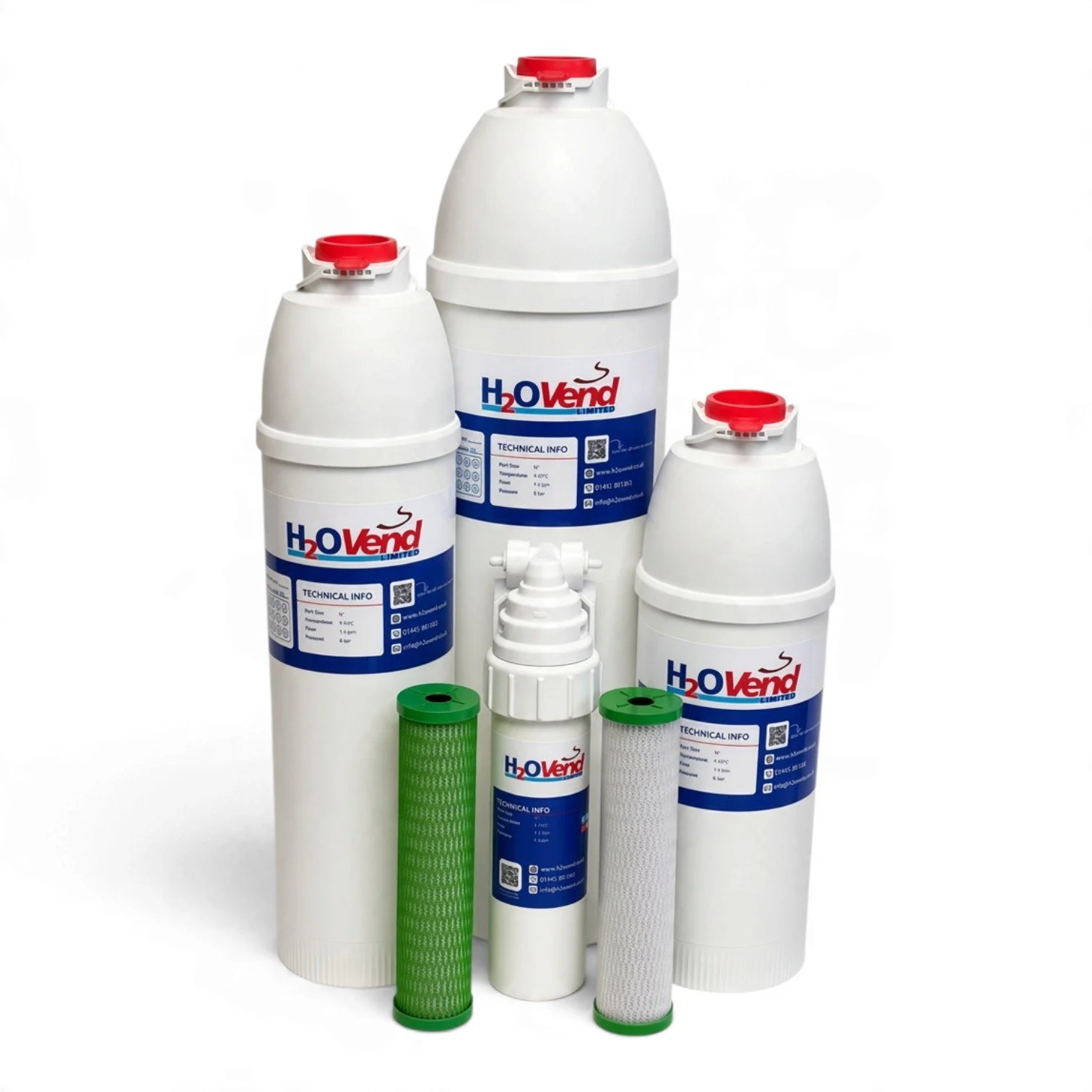
Cooler Vend uses a common refillable housing with two cartridge options. The cold-water version uses a carbon block to reduce chlorine-related taste and odour. The hot and cold version adds phosphate-based scale control to help protect heated components. Both cartridge options are available through our webshop, alongside the reusable filter housing that makes replacement straightforward.
Café Vend uses activated carbon, decarbonisation resin and an adjustable bypass head, with three cartridge sizes: Café Vend 3000, 4500 and 8000. Those numbers identify nominal litre capacities at 10°dH German hardness and bypass setting C, not a universal promise about how many litres each cartridge will treat in every location. Our engineers will still test the water and select the appropriate setup; a new label doesn't change the physics.
And although our business has traditionally concentrated on workplaces, water doesn't suddenly become less troublesome when it crosses the threshold of somebody's home. Modern kitchens increasingly contain equipment that would once have been found mainly in commercial environments. American-style fridge freezers dispense chilled water and make ice on demand, filtered drinking-water taps are becoming more common, and Quooker-style instant boiling-water taps have largely removed the need to stand around waiting for a kettle. They're wonderfully convenient, right up until somebody discovers that the replacement filter has an unfamiliar part number or hasn't been changed since the kitchen was fitted.
Many of the filtration products we supply are also suitable for compatible domestic installations, including fridge and freezer water dispensers, ice makers, filtered drinking-water taps and instant hot-water systems. As with commercial equipment, the important consideration is selecting treatment appropriate to the incoming water and the appliance. Some domestic systems require proprietary cartridges or have particular installation specifications, so compatibility needs checking rather than assuming that any filter will do.
THE EQUIPMENT MIGHT BE SMALLER, BUT THE WATER HASN'T READ THE BROCHURE.
We've also tried to make the less exciting details useful. The Café Vend labels include a technician's date-change panel, while both ranges carry a QR code directing customers to the filtration section of our webshop. For managed-service customers, replacement remains part of the maintenance arrangements. For those who own and maintain their own equipment, whether at work or at home, the cartridges and associated heads will be available to buy directly. Rather than searching for an old part number or wondering whether a replacement will fit, they can scan the label and find the range. It's not the sort of innovation likely to stop a technology exhibition, but removing a small, persistent nuisance is often more valuable than inventing an impressive new one.
The point isn't that the world urgently needs another brand of water filter. It's that filtration is already part of the work we do, and putting our name on a coordinated range makes us more accountable for the whole experience — from selecting the correct treatment to having a replacement available when it's due. The person filling a glass at the cooler doesn't want to think about carbon blocks or phosphate. The person collecting a cappuccino doesn't want to know the bypass setting. And the homeowner filling a glass from their fridge door certainly doesn't want to spend an evening researching water chemistry. They want the water to taste right, the equipment to work and a straightforward way of keeping it that way.
Which brings us back to that boiler, a quarter full of limescale. The customer hadn't called because they wanted a discussion about water chemistry. They called because their machine had stopped doing its job. The benefits of proper filtration and maintenance are seldom dramatic: no applause when a valve doesn't jam, no celebration when a heating element remains clear, and very little excitement when the cooler delivers another glass of good-tasting water. The reward is generally that nothing happens. The equipment works and everyone gets on with their day.
After over thirty years of looking after the equipment, we thought it was time to put our name on one of the small things helping to keep it that way. Not because anyone is likely to admire the filter. But because we'd rather they never had a reason to think about it.
Looking After Your Own Equipment?
Whether you're maintaining a commercial coffee machine, a workplace water cooler or a compatible domestic drinking-water system, choosing the correct filtration is essential.
Explore our H2O Café Vend and H2O Cooler Vend ranges in the H2O Vend webshop, or contact our team if you're unsure which filter is suitable for your equipment.
After all, it's only water. What could possibly go wrong?