What Happens When Nobody Buys the Cheese & Onion?
Everybody knows what they want in the vending machine. Right up until you put it in there.
A few months ago, we installed a new Smart Fridge at a customer site. We're going to keep the customer anonymous, partly because this isn't really a story about them and partly because the names have been changed to protect the innocent.
Although, strictly speaking, we haven't changed the name. We've just not told you what it is.
Before the fridge arrived, we'd done what you would imagine to be the most sensible thing possible when deciding what a workplace might like to eat and drink: we'd asked them. We sent over our usual service-fill range, together with the chilled-food options available, and invited the customer to tell us what they thought their people would want.
They came back with a list containing roughly twice as many products as the fridge could physically accommodate.
This was our first problem.
A Smart Fridge is clever, but it has yet to overcome the inconvenience of three-dimensional space. Every bottle of Coke occupies a bit that cannot simultaneously contain a sandwich. Every extra row of crisps removes somewhere you could have put chocolate. If you want four flavours of energy drink instead of two, something else has to surrender its territory.
So we did what we've been doing for years. We took the customer's requests, combined them with what our own experience suggested people were likely to buy, and built what seemed a sensible opening range.
There were drinks and crisps, chocolate and snacks, chilled food and more substantial things for lunch. Enough familiarity that nobody needed an instruction manual, but enough variety to discover what this particular workplace would make its own.
We filled the fridge, switched it on and waited.
Within days, the requests for changes began.
Some products were definitely wanted. Others weren't proving as popular as expected. There were requests for different hot snacks and a suggestion that the crisps might need another look.
So we changed things. Then we watched. Then we changed them again.
Before long, we were approaching the fifth replan of a fridge that had barely had time to become acquainted with the carpet.
You might reasonably conclude from this that we'd made a spectacular mess of planning it in the first place.
We hadn't.
We were learning.
Because there are two entirely different questions you can ask somebody:
What would you like us to put in the machine?
And:
What are you actually going to buy?
After thirty years in vending, we can tell you with some confidence that the answers are not always the same.
What People Say
Walk into almost any workplace and ask what should go in the vending machine and you'll quickly acquire a committee. Somebody wants a particular flavour of Monster. Somebody else wants protein bars. There's a campaign for different crisps. One person thinks the whole thing should be healthier, while the person standing next to them wants the largest chocolate bar legally available for sale in Britain. Somebody remembers an obscure drink they bought at a petrol station six months ago and wonders whether we can get those.
And sooner or later, somebody asks for fresh sandwiches.
Fresh food is one of the most common requests we receive. It makes perfect sense. If people are at work for eight, ten or twelve hours, particularly somewhere without a canteen, surely they'd rather have the option of buying something resembling lunch than spend the entire day choosing between crisps and Twix.
So we put sandwiches in.
And sometimes hardly anybody buys them.
That doesn't mean people were lying when they asked for them, nor does it mean the customer doesn't understand its workforce. People can genuinely value having something available without regularly choosing to spend money on it. Ask somebody whether they'd like a healthy salad available and the answer may well be yes. Put that salad next to a steak slice at lunchtime and you've conducted a rather different piece of market research.
Our new Smart Fridge demonstrated this fairly quickly. During its first few weeks, around 150 products were purchased in just over 100 transactions. That's nowhere near enough information to make sweeping declarations about an entire workforce, particularly with a new installation, but it was enough for patterns to start appearing.
Chocolate was moving. Crisps were moving. Some drinks were moving very well.
The chilled food everybody had been keen to have was moving rather less enthusiastically.
Then somebody bought one of the sandwiches and didn't like it.
In fact, they really didn't like it.
There was nothing wrong with the sandwich. It was in date, correctly stored and perfectly fit for sale. It was simply a conventional long-life vending sandwich, and if you're expecting something made that morning by a café, the two are quite different creatures. Long-life sandwiches have to survive somewhere between ten and fourteen days, which means the fillings are designed for exactly that purpose.
Across our other sites, we sell around 60 to 80 sandwiches of this type in an ordinary week. At this particular workplace, hardly any had been purchased.
And therein lies one of the more useful things we've learned about vending.
A product can be perfectly good. It can sell successfully in dozens of other workplaces. There can be absolutely nothing wrong with it whatsoever.
And it can still be completely wrong for the people standing in front of this particular fridge.
The person who disliked the sandwich gave us useful information. So did the customers elsewhere who continued buying the same product. And so did the sales figures showing that this workplace didn't appear terribly interested in sandwiches.
None of those things cancels out the others.
Feedback tells us what somebody thinks.
Sales data tells us what everybody does.
We need both.
The same applies when a popular line sells out. The immediate answer can appear obvious: visit more often. Sometimes that's exactly what we do, because service frequencies naturally increase as sales grow. But sending a van more frequently because one product keeps disappearing while several others remain stubbornly untouched isn't necessarily the cleverest solution.
Sometimes the answer is already inside the fridge.
Give the popular product more space.
Which means removing something else.
And this is usually where Trevor becomes involved.
Someone will discover another flavour of Monster and suggest we stock it. Red Bull will launch another edition. A new variety of crisps will arrive and everybody agrees it's rather good.
Trevor has been doing this for long enough that he doesn't generally begin by discussing the merits of the flavour.
He asks a different question.
“Ok. What do we take out?”
— Trevor
£30,000 Wearing Cardboard Boxes
That question links a single shelf in a Smart Fridge to everything sitting in our warehouse at Tilney.
At any given time we're carrying around 14 varieties of crisps, 13 canned drinks, 25 bottled drinks, 15 chilled products, ten frozen lines and roughly 50 different chocolates and sweets. Add the coffee, in-cup drinks, cleaning products, filters, ancillaries and bottled water needed to keep the rest of the business moving, and the total climbs beyond 200 individual lines.
When the warehouse is fully stocked, there is approximately £30,000 sitting on the shelves.
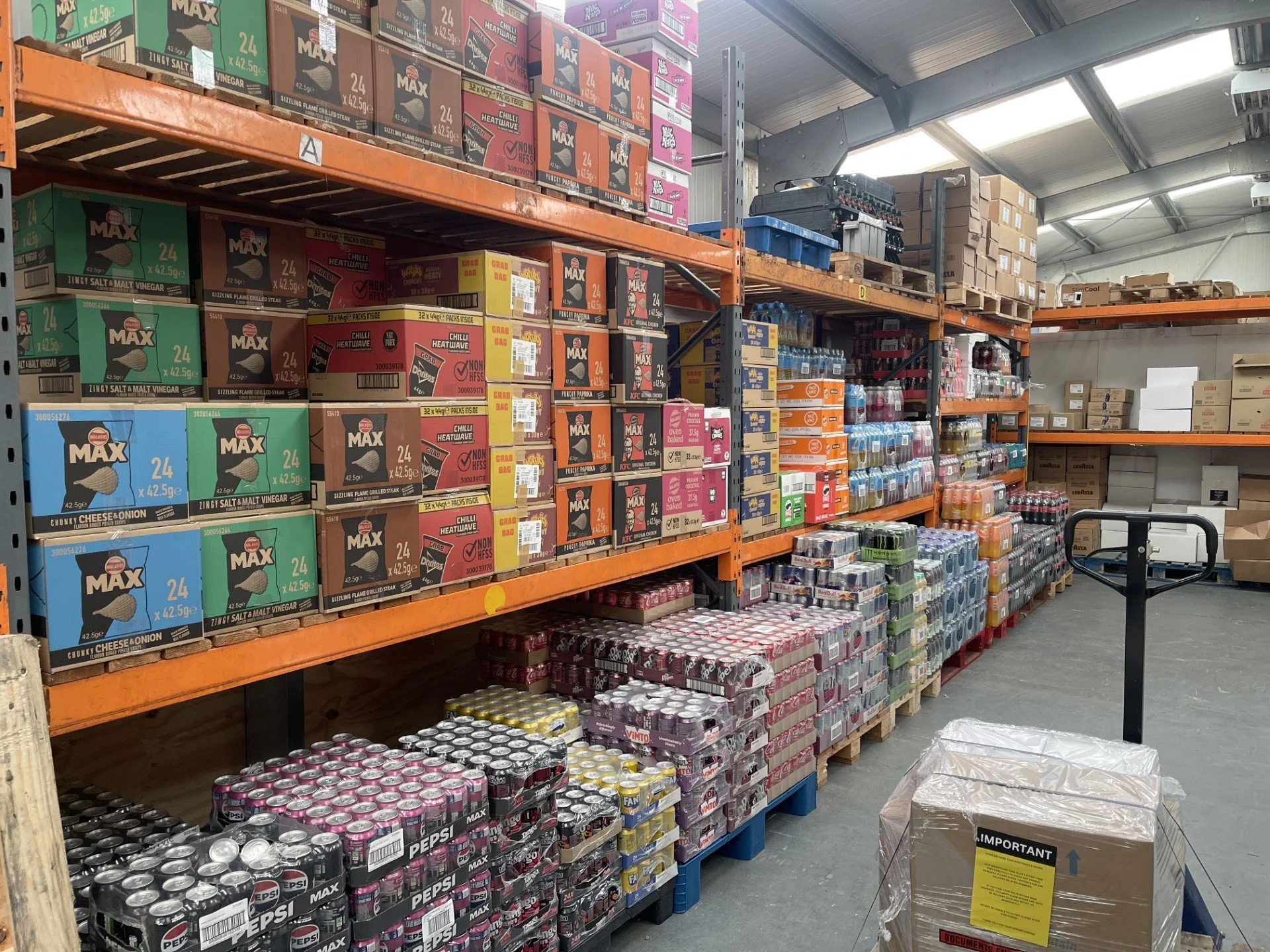
Calling it £30,000 of inventory makes it sound reassuringly abstract. It isn't. It's £30,000 of actual things, all paid for, all occupying space and, in the case of food and drink, all engaged in a slow journey towards a date printed somewhere on the packaging.
A chocolate bar or frozen product gives us around a year to discover we've made a mistake. Cans and bottles typically give us six to nine months. Crisps perhaps three to five.
Chilled food can give us seven to fourteen days.
That concentrates the mind wonderfully.
We buy by the case. We can't normally order three packets of something because Dave on the late shift thinks they'll go well. A case arrives, occupies warehouse space and then has to find its way through our machines before the calendar catches up with it.
Crisps are particularly good at causing trouble.
Manufacturers regularly launch new flavours and, initially, people genuinely do want them. Sales can be excellent for a few weeks while everybody tries the new thing.
Then everybody who wanted to try them has tried them.
The novelty fades, customer fatigue arrives and the exciting new flavour sits quietly beside the steak Walkers Max wondering why nobody loves it anymore.
We've seen this often enough that we'll generally start with perhaps ten or twelve cases of a promising new flavour. If it keeps selling, we'll buy more. If it doesn't, we'll redistribute the remaining stock.
Fortunately, we have one particularly busy site that we visit three times a week and which has acquired a useful secondary function within the H2O Vend stock-control system.
They will eat anything.
Products that have failed to fulfil their early promise can usually find a home there and, in the worst case, we'll reduce the selling price to clear them. It isn't glamorous inventory management, but it's considerably preferable to watching stock expire in the warehouse.
Dead stock isn’t just inconvenient, it’s money wearing a cardboard box.
Energy drinks present the same problem on a larger scale. Red Bull has a catalogue of roughly two dozen varieties once seasonal editions are included. Monster has around twenty. We generally stock the originals and a sugar-free option because they're dependable, recognisable and sell across a wide range of sites.
Could we stock more? Of course. We're regularly asked to.
But if we carried every Red Bull, every Monster, every new crisp flavour, every variation of chocolate bar and every drink currently enjoying fifteen minutes of fame, we'd need another warehouse and another fairly substantial pile of money to fill it.
There is also the supply chain to consider. Around 95 per cent of what we buy comes through our three main suppliers, and what they stock inevitably shapes what we can offer economically.
If somebody has spotted a product in a supermarket, they may reasonably assume we can simply order it too. Sometimes we can. Sometimes none of our main suppliers carries it. We could potentially source it elsewhere, but now one requested product might mean another supplier, another minimum order and another delivery arrangement for something that may have been requested by one person at one workplace.
The reverse happens too. A good seller can suddenly disappear from a supplier's range following a change of terms or pricing, leaving us to find another source or a suitable substitute.
To the person standing in front of the machine, their favourite product has simply disappeared.
Behind the scenes, it may have involved several phone calls, a supplier decision, a price change and Trevor standing in the warehouse looking mildly annoyed.
The Next Big Thing
None of this means we're reluctant to try new products. Quite the opposite. Samples arrive at Tilney regularly and are subjected to H2O Vend's highly sophisticated product-testing procedure.
We eat them.
There is usually a period of serious professional evaluation lasting approximately as long as it takes everybody else in the office to notice there's free food.
Opinions are offered, favourites emerge and occasionally a product is sufficiently good that finding an untouched sample for the person who was actually meant to test it becomes the principal challenge.
If something looks promising, though, the easy part is over. Trevor then has to decide whether it's being added to the range or replacing something already there.
Because liking something is easy.
Giving it permanent warehouse space is different.
We've learned that lesson the hard way.
For a few extraordinary months, Prime looked like precisely the sort of product every vending company dreams about. Demand was enormous. People hunted for it. Retailers struggled to keep it on shelves and bottles were discussed with an enthusiasm normally reserved for concert tickets.
So we stocked it.
And it sold.
Then, with the remarkable efficiency that only consumer fashion can achieve, everybody seemed to stop caring.
Unfortunately, the public's decision to move on wasn't synchronised with the amount of Prime already sitting in our warehouse. We were left with a considerable quantity to clear.
Buying the next big thing isn't particularly difficult.
Knowing when it has stopped being the next big thing is harder.
The Strange Economics of a Twix
Even if we've established that a product will sell, can source it reliably and have somewhere to put it, there's another reason the same range and prices don't simply appear in every H2O Vend machine.
Not every machine is provided on the same commercial basis.
Our food and drink prices operate in bands, with each new customer allocated the appropriate band according to the arrangement under which we're providing the equipment and managed service. A customer paying a service rental is already contributing towards the cost of the equipment. A customer with a machine supplied Free on Loan isn't.
That doesn't mean the machine is actually free. It means the customer isn't paying for it directly.
Somebody still has to.
The product sales therefore have to contribute towards the depreciation of the machine, the operator who drives out to fill it, wages, van, fuel, maintenance and the rest of the infrastructure required to make a vending machine sit quietly in the corner looking as though all it needs to function is electricity and optimism.
There also needs, eventually, to be a profit. We have mentioned this quietly to the accountants and apparently they're quite keen on the idea.
As a result, exactly the same chocolate bar could be £1 in one machine, £1.20 in another and perhaps £1.50 somewhere else. It hasn't become 50 per cent more chocolatey during the journey. It's simply supporting a different commercial arrangement.
When we install new equipment, the capital cost generally has to be recovered across the secured duration of the agreement, typically three or five years. At some healthcare, education and public locations there may also be a percentage royalty paid back to the host organisation. At lower-volume or unestablished sites there may instead be a weekly service or provision charge, sometimes with a royalty helping to offset that fixed contribution as sales develop.
Then someone taps their phone against the card reader.
More than 90 per cent of our transactions are now cashless. A typical cashless terminal costs us £13.50 per month per machine plus a transaction charge of around 3.5 per cent. Depending on the agreement, those costs may be incorporated into the selling price or charged separately.
The customer sees a Twix.
Behind the Twix is a surprisingly complicated little financial ecosystem.
And occasionally, after we've established that the customer wants something, the sales data says people will buy it, Trevor has agreed to stock it, our suppliers can provide it and the numbers work, we encounter one final problem.
We're not allowed to put it in.
Different workplaces have different requirements. Healthcare environments may have CQUIN standards to consider. Some sites are nut-free. Machines used by younger people can have restrictions around energy drinks. Some production environments want bottles rather than cans to reduce the consequences of spillages. Other employers actively request healthier choices as part of their staff-welfare policies.
Then there are colleges, where we've occasionally encountered the reverse of the argument everybody expects to have about vending prices.
They impose a minimum selling price.
The reason is perfectly logical. If the college operates its own shop or catering facility, it doesn't particularly want our vending machine parked nearby selling the same drink for less and quietly stealing its customers.
Most people assume the commercial problem with vending is preventing prices from becoming too high.
Sometimes our job is making sure they're not too low.
What Thirty Years of Empty Spirals Tells You
Do this for long enough and you begin to notice things.
Not grand consumer trends of the sort presented at conferences by somebody wearing a headset microphone. Smaller things. Patterns that emerge only after years of watching what disappears from machines and what comes back in the van.
Factories, for example, tend to eat more calories. Large chocolate bars, flapjacks, stronger crisp flavours and energy drinks generally perform well. Offices tend to lean a little lighter, towards crisps, Kinder Bueno, smaller snacks and diet drinks.
These aren't rules. They're patterns, and they're useful when we're planning a new site with no sales history of its own.
The workforce can alter the pattern too. Sites with predominantly male workforces tend towards larger snacks, stronger flavours, flapjacks and energy drinks, while sites with predominantly female workforces often lean towards smaller snacks, lighter choices, Bueno and diet drinks. Again, these are observations from what we've seen across our own machines, not instructions for how men and women are supposed to eat. Put a vending machine in front of fifty actual human beings and they'll soon dismantle any theory that's become too confident.
Time of day changes things again. Night-shift vending can be a completely different business from daytime vending. At police and ambulance sites in particular, ready meals, chocolate and energy drinks become more important because the machine isn't necessarily providing somebody with an afternoon snack.
At three o'clock in the morning, it may be providing dinner.
Gyms have their own behaviour. Energy drinks move, as you'd expect, but so do Lucozade Sport, bottled water, protein drinks and health bars. Huel and other meal-replacement or protein drinks have been particularly interesting because their relatively high selling price might suggest they'd struggle in vending.
Instead, they're growing.
Then there is the weather. A proper hot spell can rearrange sales almost overnight as drinks disappear faster than expected. January does something similar in the opposite direction to chocolate and snacks, when large parts of Britain apparently wake on New Year's Day having decided that this is finally the year in which everything will be different.
For a while, it is.
Then things gradually return to normal.
The working week has a shape too. Across our estate, purchasing tends to form something resembling an M. Monday starts strongly, Tuesday drops and Wednesday is generally the trough. Thursday begins climbing again and Friday peaks. At workplaces operating over the weekend, sales tend to fall back to something around Wednesday levels.
Payday produces another spike.
Nobody taught us about the M-shaped British snacking week when H2O Vend started thirty years ago. It's simply one of those things you discover after filling enough machines.
And yet, for all that accumulated experience, there remain products which cheerfully refuse to behave as expected.
Kinder Bueno is perhaps our favourite example.
Nobody asks us for Kinder Bueno.
Nobody rings the office campaigning for it. Customers don't generally put it at the top of their requested-product lists. There is no noticeable workplace movement demanding better access to Bueno.
It is our biggest-selling standard chocolate bar by far.
People don’t ask for Kinder Bueno, they just buy it.
Fresh chilled food frequently does the opposite. People ask for it because they genuinely like the idea of having it available. Then, at some workplaces, relatively little sells and we either reduce the range substantially or remove it.
At the other end of the spectrum are products such as Huel and protein drinks. They're comparatively expensive, so you might reasonably expect price to hold them back. Instead, demand is growing.
Sugar-free drinks are another steadily expanding part of the range, increasingly including sugar-free energy drinks.
And beneath all the surprises sit the products we've learned are dependable starting points: Walkers Max steak, paprika and cheese & onion; flapjacks; Coke and Pepsi Max; Monster and Red Bull; Twix and Kinder Bueno; Duo Mars, Snickers and Twix bars; and Lucozade Sport, particularly around younger customers and sporting environments.
They won't perform identically everywhere. Nothing does.
But when you're standing in front of an empty machine at a brand-new site with no sales history whatsoever, thirty years of experience has to count for something.
Then the customers take over.
Next Tuesday
Technology has transformed our ability to understand what happens after that first fill.
Years ago, much of the knowledge lived with the operator. They knew which spirals were empty, what they kept putting back in and which products seemed to require dusting rather than replenishing.
That human knowledge still matters enormously. But cashless systems, telemetry and Smart Fridges now give us something previous generations of vending operators would have loved.
They tell us what actually sold.
We can see which products moved, how many were bought and when. Instead of looking at an empty shelf and making an educated guess, we can increasingly see the transaction history behind it.
But there's an important distinction.
Data is very good at telling us what happened.
It's less good at telling us what somebody will fancy tomorrow.
If a product sells out, was it because everybody loves it or because we didn't put enough in? If another doesn't sell, is it genuinely unpopular or does it simply need more time? If chilled food struggles during the first fortnight, have we chosen the wrong range or have people not yet changed their lunchtime habits? If sales suddenly drop, has the product lost favour, are half the staff on holiday, has the weather changed, or is everybody simply waiting for payday?
The numbers matter enormously.
But so does the customer.
So does the operator.
So does experience.
The computer knows what sold. The operator knows the customer. Neither can see next Tuesday.
Which takes us back to the Smart Fridge we installed a few months ago.
Before we'd sold a single product through it, everybody involved was trying to solve the same problem. The customer had ideas about what their people wanted. Individual employees had favourites. We had thirty years of experience telling us what normally works. Our suppliers determined what was readily available. The dimensions of the fridge determined how much would fit. Shelf life determined how adventurous we could afford to be.
Then people started buying things.
And the fridge began contributing its own opinion.
Some of the customer's instincts proved right. Some products disappeared quickly enough to justify more space. Others, despite having been specifically requested, didn't perform as expected. Chilled food needed reconsidering. The balance between drinks and snacks changed. By the fifth replan we knew considerably more about that workplace than we had when the original list of requested products arrived.
That doesn't mean the first plan was wrong.
It means it was the first plan.
There is a temptation in business to believe that good service means knowing the answer before anything happens. Experience ought to count for something after thirty years, but good vending isn't about pretending we can perfectly predict what a group of human beings will decide to eat.
It's about being good enough to notice when they tell us.
Sometimes they tell us by email. Sometimes they tell the operator while the machine is being filled. Sometimes they tell us by emptying an entire row of steak crisps in two days.
And sometimes they tell us by leaving the cheese & onion exactly where we put it.
So we listen to the customer. We listen to the operator. We watch the sales and look at what disappears, what doesn't, what works everywhere and what only seems to work here. We give successful products more room and unsuccessful ones less. We try new things. Occasionally we get caught out by Prime. Occasionally something expensive like Huel surprises us. And occasionally the product nobody has ever asked us for becomes the biggest-selling chocolate bar in the business.
After thirty years, we've become considerably better at predicting what people will buy.
We've also become considerably more comfortable admitting that sometimes we haven't got a clue.
Which is why, sooner or later, somebody will walk into the office carrying a sample of the latest new flavour of crisps. The packet will be opened. Everybody will try one. Somebody will say they're brilliant. Somebody else will say they'd definitely sell. There will be a brief discussion about which customers would love them.
And somewhere in the background, Trevor will ask the question he has been asking for years.
“OK. What do we take out?”