You’ve Run Out of Coffee Beans. Now What? The Curious Story of Instant Coffee
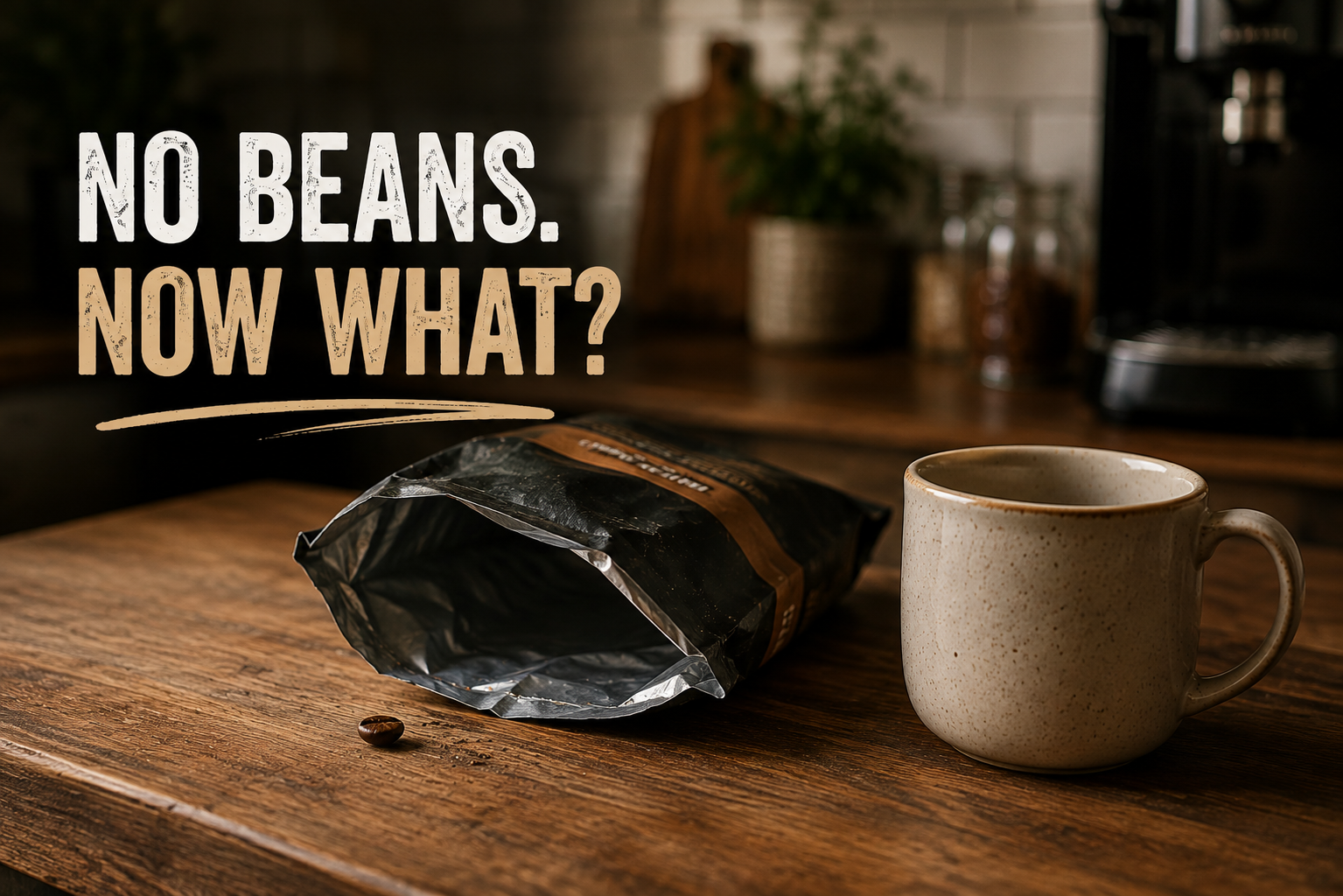
There are few domestic emergencies quite as unsettling as opening the kitchen cupboard first thing in the morning, reaching confidently for the bag of coffee beans… and discovering that somebody has used the last of them.
You shake the bag.
Nothing.
You turn it upside down, because apparently gravity may have missed one.
A solitary fragment falls onto the worktop.
Not even a bean. Just a bit of one.
Brilliant.
The coffee machine sits beside you looking equally disappointed.
And then you spot it.
Right at the back of the cupboard. Behind the gravy granules, next to a tin of something with a best-before date that really shouldn't be investigated too closely.
Instant coffee.
You stare at it.
It stares back.
Needs must.
But while you're waiting for the kettle to boil, there's an interesting question worth asking.
What actually is instant coffee?
Because despite what coffee purists might tell you, instant coffee really is coffee. And the journey from a green coffee bean to those little brown granules in the jar is considerably more complicated than you might imagine.
It Starts With a Coffee Bean
The process begins in much the same way as the coffee going into your bean-to-cup machine.
Green coffee beans arrive at the factory, they're cleaned, roasted and then ground.
Except we're not talking about the little grinder sitting on your kitchen worktop.
Industrial coffee production operates on an entirely different scale, with enormous roasters and grinders processing hundreds of kilograms at a time.
The ground coffee is then brewed.
Again, imagine making a cafetière.
Now imagine your cafetière is roughly the size of something you'd expect to find at Sizewell B.
The resulting coffee is filtered and concentrated by removing much of the water, eventually producing a thick coffee extract.
And this is where things get clever.
The manufacturer now has to turn a huge quantity of liquid coffee back into something dry that can sit happily in a jar for months and magically become coffee again when you add water.
There are two main ways of doing it.
Spray-Dried or Freeze-Dried?
The cheaper method is spray drying.
Concentrated coffee is sprayed into extremely hot, fast-moving air. The droplets lose their moisture almost instantly and fall as a dry coffee powder.
It's incredibly efficient and relatively inexpensive.
Unfortunately, some of those lovely volatile coffee aromas disappear during the process as well.
The more premium approach is freeze drying.
The concentrated coffee is frozen at extremely low temperatures, broken into granules and placed under a vacuum. The frozen water is then removed through a process called sublimation, where ice effectively changes directly into vapour without becoming liquid again first.
Coffee manufacturers can even capture some of the aromas released earlier in production and add them back towards the end.
Which is rather more engineering than you'd expect to have gone into the teaspoon of brown stuff you've just reluctantly put into your mug.
Why Robusta?
There's another reason instant coffee often tastes noticeably different from freshly ground coffee.
Robusta.
There are two coffee species you're most likely to encounter commercially: Arabica and Robusta.
Arabica generally delivers the smoother, sweeter and more aromatic flavours associated with premium coffee. Robusta tends to be stronger, earthier, more bitter and higher in caffeine.
It's also considerably easier and cheaper to grow.
Robusta plants are hardy, productive and can grow successfully in conditions where Arabica can be rather more temperamental.
And when you're manufacturing coffee on an enormous scale, economics inevitably enters the conversation.
There's also limited benefit in taking an exceptionally delicate, expensive speciality coffee and putting it through industrial extraction, concentration and drying processes that inevitably remove some of the subtle characteristics you paid all that money for in the first place.
It would be a little like buying a Wagyu steak and putting it through a mincer to make a burger.
A very good burger, perhaps.
But still.
And Then There Was Chicory...
Which brings us to something those of a certain age may remember.
Camp Coffee.
Remember that tall bottle of dark brown coffee essence lurking in your parents' or grandparents' cupboard?
Camp Coffee has been around since the Victorian era and is a concentrated coffee-and-chicory essence. You simply added it to hot water or, more commonly in many households, hot milk.
And long before today's world of flat whites, double espressos and arguments about oat milk, that counted as conveniently instant coffee.
Chicory itself is a plant, and its root can be roasted to produce a dark, bitter, coffee-like flavour.
Historically, chicory was frequently mixed with coffee or used as a substitute when coffee was expensive or difficult to obtain.
And there was an obvious commercial advantage.
Coffee cost money.
Chicory cost rather less money.
You didn't need to be an accountant to see where this was heading.
The practice became widespread enough in Britain during the nineteenth century for arguments about coffee being adulterated with chicory to actually reach Parliament.
But coffee-and-chicory also became a flavour in its own right.
Camp Coffee became enormously popular and is still available today. Although these days you're arguably more likely to find it being added to a coffee cake or buttercream than being offered to somebody after dinner.
For many people, though, one glimpse of that distinctive Camp Coffee bottle immediately transports them back to their grandparents' kitchen.
Food and drink have a funny habit of doing that.
Back to the Cupboard
The kettle clicks.
You've now spent so long thinking about industrial freeze dryers, Robusta plantations and Victorian coffee substitutes that you've almost forgotten the original problem.
There are still no beans.
So you spoon the instant granules into your mug, pour in the water and take a sip.
And actually...
It's alright.
Modern instant coffee is considerably better than the instant coffee many of us grew up with. Freeze-drying, better blending and improved aroma recovery have transformed the quality.
And convenience matters.
There's a reason instant coffee became such an enormous success. No grinder. No brewer. No mess. No waiting.
Spoon.
Water.
Coffee.
It's quite an extraordinary bit of food engineering when you think about it.
But tomorrow?
You're buying more beans.
Because clever though instant coffee undoubtedly is, there's still something rather special about opening a fresh bag of coffee beans, hearing the grinder start and getting that first smell of freshly ground coffee.
It's something we've always believed at H2O Vend.
You can have the smartest machine in the world, but ultimately the machine is only the vehicle.
What you remember is the coffee in the cup.
And occasionally, apparently, you remember to buy some more beans!